

MycoMorphosis: Dancing with Fungi
Directed and Choreographed by Iván-Daniel Espinosa
Premiered at:
* The Dairy Arts Center, Boulder Colorado — 2026


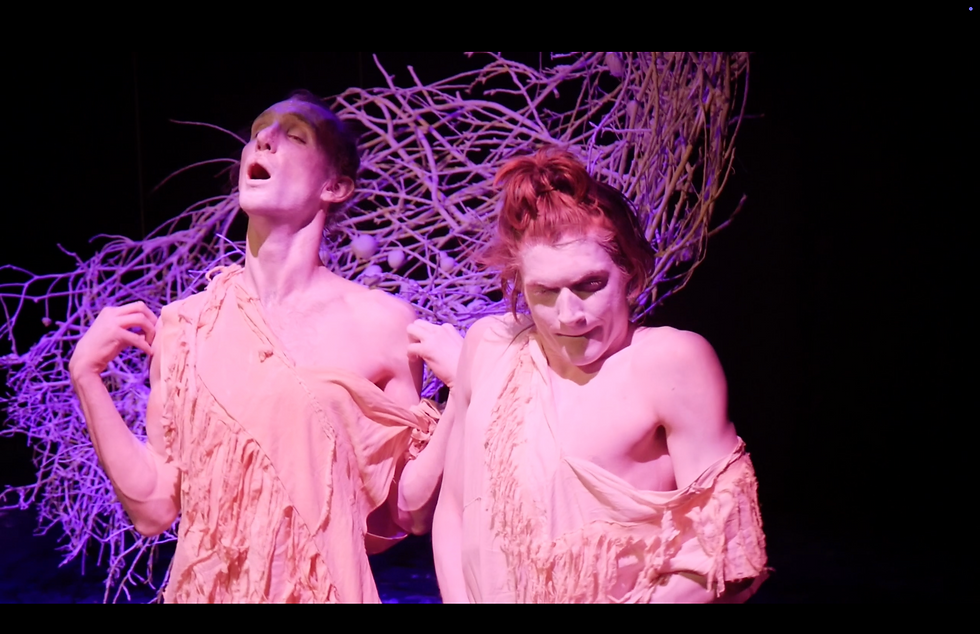

Dance Ensemble for MycoMorphosis: Dancing with Fungi:
* Stefan Bach
* Corin Wiggins
* Arlo Sage King
* Kenji Hirose
Sculpture by:
* Arlo Sage King
Commissioned musical soundscape composed and performed by:
* Christopher Arnett
ABOUT the performance:
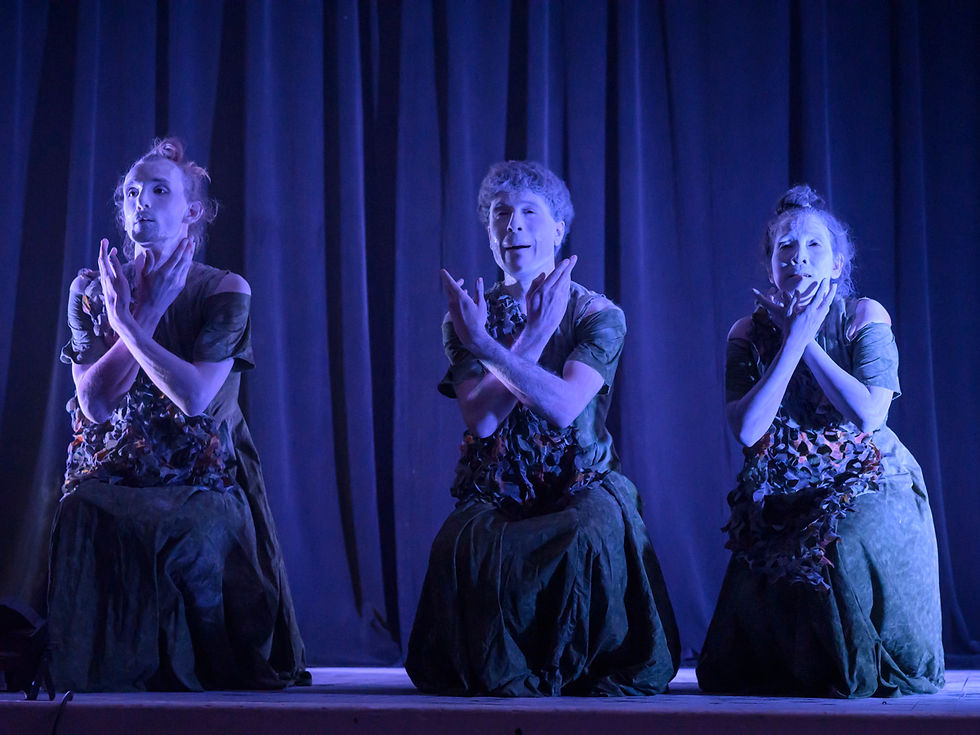
MycoMorphosis: Dancing with Fungi is a multimedia dance performance that engages sonically and sensorially with the vibrant materiality of mycelium fungi and fungal ecologies. Exploring the intersections of mycology and performance, this artwork integrates amplified mycelial bio-data sonification and fungal bioacoustics from mushroom colonies of diverse species with Japanese Butoh dance to immerse audiences into the shapeshifting world of fungi, while offering insight into the complex relationships between humans, nature, and technology. The performance also incorporates an eight foot tall hanging sculpture constructed from foraged earthly detritus and local mushrooms to evoke the underground webs of mycelium that cover the earth’s forest floors.
Scattered throughout the forests of the earth, fungal mycelium forms what scientists call the wood wide web: vast, underground symbiotic networks of fungi that connect the roots of thousands of plants and trees and play a key role in maintaining the health and wellness of our planet. In the words of mycologist Merlin Sheldrake “mycelium is ecological connective tissue, it’s the living seam by which much of the world is stitched into relation.” Ecological relation and connection to the earth are also fundamental to the practice of Butoh. According to Butoh scholar Rosemary Candelario, “Butoh acts as a kind of ecological methodology, reminding participants and witnesses that they are not isolated from their surroundings.” She further emphasizes that there is something deeply ecological about Butoh dance that cultivates “a radically reordered corporeality, a bodily sensitivity to connections constituted by the ecology itself, and an embodied and practiced ecological consciousness fundamentally attuned to interdependence.” With physical movements that move towards the earth and the subconscious, Butoh dancers crawl close to the ground like the mushrooms on the forest floor that are colorful indicators of a mysterious mycelial world that lies just out of sight, and is dancing just under our feet. At its heart, MycoMorphosis: Dancing with Fungi is an interspecies performance that engages with themes that are fundamental to both the fungal realm and the realm of Butoh: interconnectedness, corporeality, bioelectricity, decomposition and decay, the body as a landscape,and the landscape as a body. Through the integration of mycology and dance with musical soundscapes that are co-created with live fungal bio-data sonification, this performance creates a MULTI-SENSORY experience that demonstrates a deeply intimate relationship to the earth, where the distinctions between human and non-human worlds disintegrate in slow and metamorphic bodily practice.

** MycoMorphosis: Dancing with Fungi was funded and supported in part by a Community Project Grant from the Boulder Arts Commission, an agency of the Boulder City Council. This project was also supported by additional grant funding from the CU-Boulder Office for Public and Community-Engaged Scholarship and the Nature, Environment, Science & Technology (NEST) Studio for the Arts.
Plucking off the Darkness of the Galaxy
Directed and choreographed by Iván-Daniel Espinosa
Toured internationally and performed at:
** Kyoto International Butoh Festival, Kyoto Japan — 2026
** Banryū-ji Buddhist Temple, Tokyo Japan — 2026
** Kanazawa Butoh-Kan Kura Studio, Kanazawa Japan — 2026
** Salish Sea Butoh Festival, Port Townsend WA — 2026
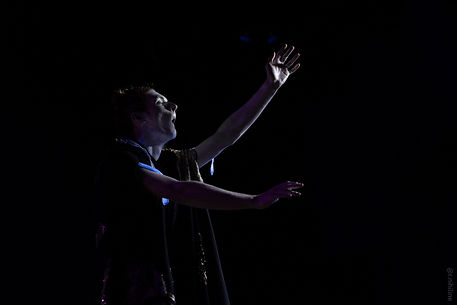
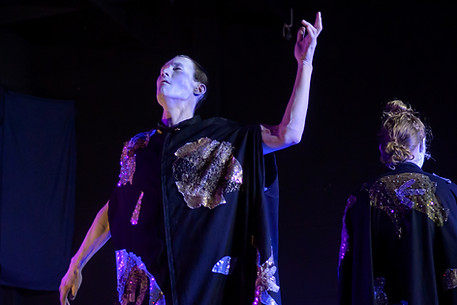


Dance Ensemble for Plucking off the Darkness of the Galaxy:
** Stefan Bach
** Corin Wiggins
** Kenji Hirose
Commissioned musical soundscape composed and performed by:
Katinka Kleijn
Costume design by:
Monica Pasut
ABOUT the performance:
Plucking off the Darkness of the Galaxy is a meditation on the body's primordial connection to the stars in our galaxy as well as interstellar matter from supernovas. According to astrophysicist Karel Schrijver, the human body contains stardust as old as the universe itself — and some that may have landed on Earth just a hundred years ago. In his book co-written with Stanford University Professor Iris Schrijver, Living With the Stars: How the Human Body Is Connected to the Life Cycles of the Earth, the Planets, and the Stars, he tells us that "everything we are and everything in the universe and on Earth originated from stardust, and it continually floats through us even today. It directly connects us to the universe, rebuilding our bodies over and again over our lifetimes." This research brings new meaning to the phrase ‘we are made of star stuff’ and how the atoms in our bodies were forged within the fiery cores of stars dispersed by supernovae.
The title of the piece is adapted from a quote by the founder of Butoh, Tatsumi Hijikata, in which he describes Butoh as a dance of “plucking off the darkness of the flesh.” This performance re-contextualizes Hijikata’s imperative in service of plucking off the galactic matter of the flesh, and dancing with the remnants of ancient stars teeming inside our bodies that scattered across the universe when they exploded. The choreography takes its inspiration from a 1968 interview of Tatsumi Hijikata originally published as "Nikutai no yami o mushiru" in Tenbō magazine. Throughout the interview, Hijikata discusses his perspective on art, corporeality, Butoh, and the body’s primordial relationship to nature and the non-human realm. Hijikata articulates how Butoh is not just an aesthetic but also a profound ontology of the body for excavating the darkness from within. He says that dancers ought to “drop a ladder deep into their own bodies and climb down it. Let them pluck the darkness from within their own bodies and eat it.” Incorporating choreographic phrases from Hijikata’s 1970’s renzoku kōen performances that emphasize transformation and death, the performance aims to evoke a deep connection to larger, ongoing cycles of living and dying galactic matter.
The music for this performance, composed by cellist Katinka Kleijn, features electroacoustic soundscapes inspired by cosmological recordings from NASA and The National Radio Astronomy Observatory. Much of Kleijn’s music illuminates the cello’s anthropomorphic qualities, often by placing the instrument in thought-provoking new contexts. Combining this musical approach with the nature-themed Butoh dance scores, the performance reflects a world in which the body is in a constant state of flux, and human life is not isolated but intimately tied to the life cycles of the stars in our galaxy.
BOWELS OF THE EARTH
Directed and Choreographed by Iván-Daniel Espinosa
Toured internationally and performed at:
* Northwest Butoh Festival, New Expressive Works, Portland OR — 2026
* Ecological Intimacies of Butoh Conference, University of Colorado-Boulder, Loft Theatre —2026
* BUTOHRESQUE: Vienna International Butoh Festival, Off-Theater, Vienna Austria — 2025
* Salish Sea Butoh Festival, Port Townsend WA — 2025
* bim bom studios, Chicago IL — 2025
* NextGen Butoh Lovers Showcase, Dovetail Studios, Chicago IL — 2025
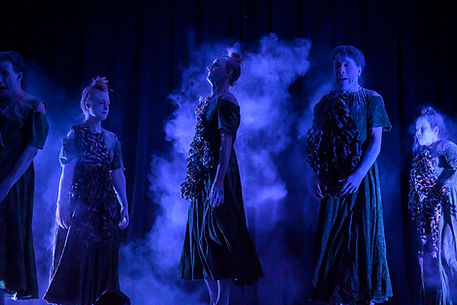



Dance Ensemble for Bowels of the Earth:
* Stefan Bach
* Harlan Rosen
* Corin Wiggins
* Arlo Sage King
* Wannapa Pimtong-Eubanks
Commissioned musical soundscape composed by:
* Christopher Arnett
ABOUT the performance:
Bowels of the Earth is a meditation on the human body's connection to ecologies of death and decomposition. Iván-Daniel’s choreography takes its inspiration from a text by the founder of Butoh Tatsumi Hijikata known as "Kaze Daruma". Originally titled "Suijakutai no saishu", this text was delivered as a lecture by Hijikata the night before the 1985 Tokyo Butoh Festival. In this lecture, Hijikata emphasized the body's intimacy with ecological forces like wind, mud and soil, and portrayed Butoh as a unique type of performed ecological knowledge that disrupts Euro-Western ideologies of Anthropocentrism, delineated corporeality and their preconditioned behaviors. A transformative experience of nature was important to Hijikata: while articulating his complex attitude toward performance, Hijikata declared that Töhoku's spring season with its abundance of mud and wet soil taught him to dance. Also in his lecture, Hijikata touches on his concepts of "rotting ma" (kusatte iru ma) and "suijakutai" (translates to 'weak', 'emaciated' or 'weakening' body), and how the performance of this suijakutai body in Butoh reflects the coexistence of life and death. Indeed, from its inception, the theme of death has been recurring, if not instrumental, in Butoh performance. As the chief architect of Butoh, Hijikata is quoted as saying such things as, "butoh is a corpse standing upright in a desperate bid for life.” In his "Kaze Daruma" lecture, Hijikata also emphasized Butoh's expansive relationship with death by stating: "I would like to have a person who has already died die over and over inside my body. I may not know death, but death knows me. I often say that I have a dead sister living inside my body. When I am absorbed in creating a butoh work, she plucks the darkness from my body and eats more than is needed. For me to fall is for her to fall... She's my teacher; a dead person is my butoh teacher."
Decomposition is what happens to the human body after death: we return to the soil, and become a part of the subterranean earth. Decomposition is also the force of nature that radically transforms the dying human self into new organic life. How can a dance of decomposition act as a kind of ecological praxis, reminding us that we are not separate from nature and the environment nor from the decaying aspects of life in which all beings, bodies, and entities are entangled? In its descent toward the mud and sod of the earth, Butoh invites us to dance and commune with death and decomposition. In the words of Hijikata, "the dancer, through the butoh spirit, confronts the origins of his fears: a dance which crawls towards the bowels of the earth."
